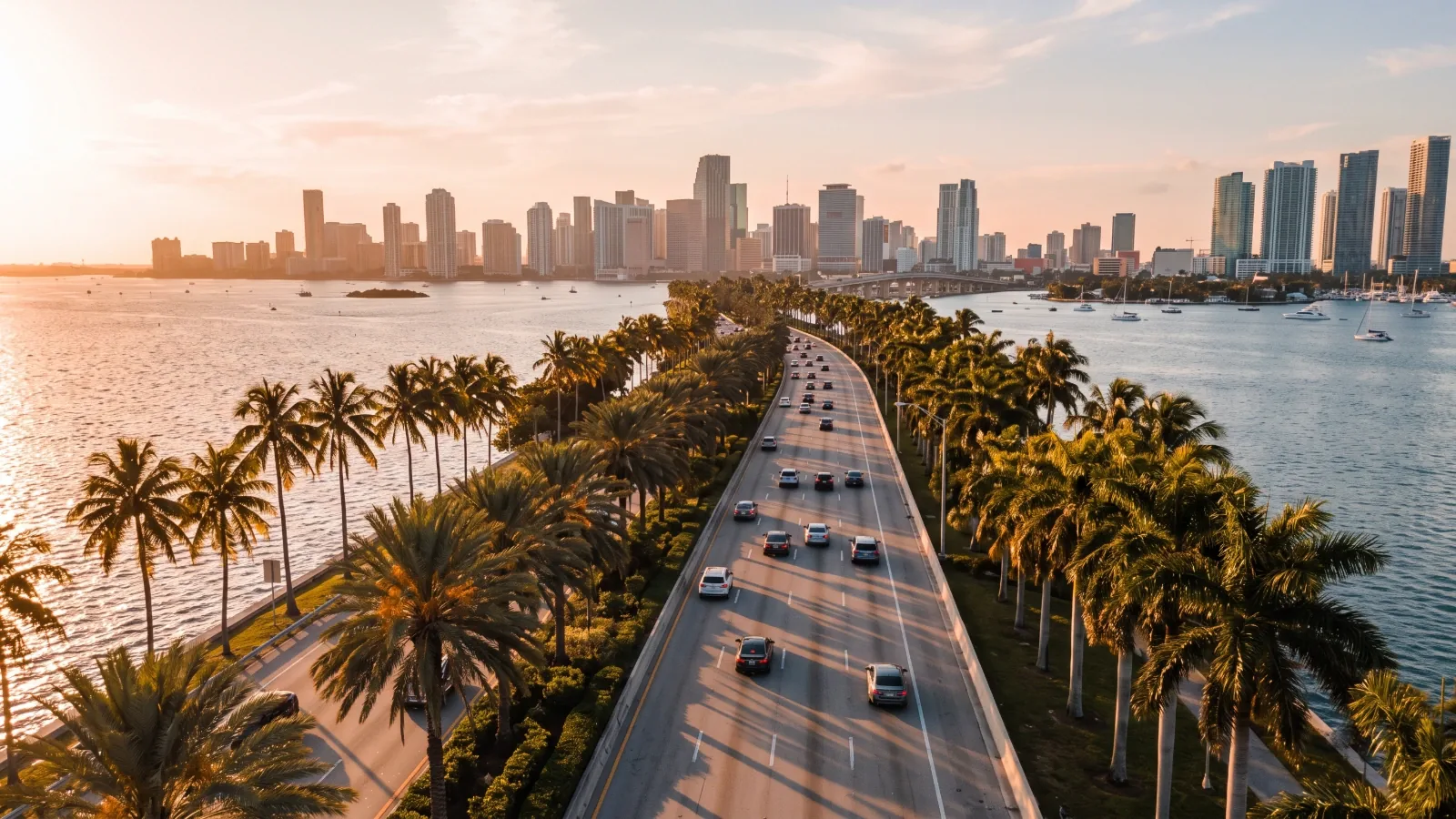
Moving to Miami to rent in 2026: rents by county, where to look, move-in costs, Florida renter law, hurricanes and scams, with links to every guide.
If you're moving to Miami and plan to rent, budget about $2,600 a month for a one-bedroom in a newer building: the median starting base rent in Miami-Dade was $2,603 in October 2026, before required fees of about $71. Broward is cheaper, at $2,286. Plan for move-in fees, Florida's renter rules and hurricane season, June 1 to November 30.
This guide pulls together our research on 410 purpose-built rental buildings in Miami-Dade, Broward and Palm Beach counties, each owned by one company and leased through its own office. We read their rents, fees and specials on October 12 and 13, 2026. Each section links to a detailed guide, and the table near the end lists every MiaRent renter guide by topic.
How much does it cost to rent in Miami and South Florida?
These are median starting base rents in purpose-built rental buildings as of October 2026, before required fees. Each figure is the median of each building's lowest advertised base rent for that size, and the number of buildings behind it is in brackets.
| County | Studio | 1 bedroom | 2 bedrooms | 3 bedrooms |
|---|---|---|---|---|
| Miami-Dade | $2,350 (35) | $2,603 (102) | $3,312 (69) | $4,394 (41) |
| Broward | $2,027 (26) | $2,286 (65) | $2,753 (53) | $3,419 (34) |
| Palm Beach | $2,427 (10) | $2,575 (38) | $3,083 (36) | $3,585 (22) |
Within Miami-Dade, the median one-bedroom runs from $1,871 in Miami Gardens to $3,386 in Coral Gables. Our average rent guide has the full table by neighborhood and unit size. Studios have their own guide, studio apartments in Miami, and so does the top of the market, luxury apartments in Miami.
Rent is the biggest line in a Miami budget. In the Bureau of Labor Statistics (BLS) Consumer Expenditure Survey for 2023-24, Miami-area households put 40.0 percent of their spending into housing, against 33.2 percent nationally. Prices are still climbing: in the 12 months to August 2026, the BLS rent index for the Miami-Fort Lauderdale-West Palm Beach area rose 2.4 percent and overall prices 3.7 percent. For electricity, transit, food and taxes, see the cost of living guide for renters.
What fees come on top of the rent?
Most new buildings add required monthly charges for things like trash, pest control, package lockers, internet or an amenity fee. Among the 39 buildings in our data that publish both a base rent and a total monthly price, those fees added $0 to about $235 a month, with a median of about $71. Another 69 buildings list only a total, with fees already included and no breakdown. That's why it pays to compare total monthly prices on the same lease length. Parking, pets and metered utilities usually cost extra again, and fees beyond rent has every figure.
Electricity is usually on you. If your building is served by Florida Power & Light, 1,000 kWh costs about $133 before taxes at its residential rates effective October 2026, and many new buildings also bill water, sewer and trash separately or through a submeter. Ask each building which utilities you'll pay and how they're billed.
Specials can offset some of it. On October 13, 2026, 105 of the 388 buildings that were leasing or in lease-up advertised free rent or a similar concession, from half a month to three months. Free months lower your average cost, not your monthly payment, and some buildings quote the averaged figure. Net effective rent and move-in specials shows how to compare offers.
How much income do you need to rent in Miami?
Many buildings ask for household income of three times the monthly rent. Eighteen buildings in our files state that rule outright, and three state 2.5 times the rent. At the Miami-Dade median one-bedroom rent, three times the rent is about $7,800 a month, or about $93,700 a year. For comparison, Miami-area households had an average income before taxes of $89,053 in the BLS survey for 2023-24.
Buildings also screen your credit and background and ask for proof of income. If a landlord turns you down because of a tenant screening report, the Consumer Financial Protection Bureau says it must tell you, name the company that supplied the report, and explain your right to a free copy within 60 days and to dispute errors. Apartment application requirements covers income, credit and the 3x rule, and our affordability calculator checks a rent against your income.
Where should you live when moving to Miami?
Start with your commute, then your budget. Our catalog covers 76 areas across the three counties, and 42 of them have at least three rental buildings and a page of their own. The most buildings are in Fort Lauderdale (38), West Palm Beach (28), Midtown/Wynwood (21), Doral (18), Downtown Miami (16) and Brickell (15).
| County | Rental buildings | Median 1-bed base rent (priced buildings) | Areas with their own page |
|---|---|---|---|
| Miami-Dade County | 217 | $2,603 (102) | Allapattah, Aventura, Brickell, Coconut Grove, Coral Gables, Dadeland, Doral, Downtown Miami, Edgewater, Flagami, Hialeah, Homestead, Kendall, Liberty City, Little Havana, Miami Beach, Miami Gardens, Midtown/Wynwood, Naranja, North Miami, North Miami Beach, Overtown, Princeton, Upper Eastside |
| Broward County | 118 | $2,286 (65) | Dania Beach, Davie, Fort Lauderdale, Hallandale Beach, Hollywood, Miramar, Pembroke Pines, Plantation, Pompano Beach, Sunrise |
| Palm Beach County | 75 | $2,575 (38) | Boca Raton, Boynton Beach, Delray Beach, Lake Worth Beach, Palm Beach Gardens, Royal Palm Beach, Wellington, West Palm Beach |
Areas with one or two rental buildings, such as South Miami, Coral Springs or Jupiter, are listed on the county pages. In Miami-Dade, the choices sort roughly like this:
- To walk to work and ride rail: Brickell and Downtown Miami hold 31 rental buildings between them, with Metrorail and the free Metromover at their center. Their median one-bedrooms are $2,808 and $2,855.
- For the most choice and the most specials: Midtown/Wynwood, where 10 of 21 buildings advertised free rent on October 13 and the median one-bedroom is $2,832.
- For bay views: Edgewater, with 13 rental buildings along the bay and a median one-bedroom of $3,058.
- For lower rents: Miami Gardens at $1,871, Allapattah at $2,187, Dadeland at $2,199, with Metrorail, and Hialeah at $2,334.
- For a quieter setting at higher rents: Coral Gables at $3,386 and Coconut Grove at $3,069.
- West of the airport: Doral, with 18 rental buildings and a median one-bedroom of $2,450 across the six that publish a base rent.
Our guide to where to live in Miami compares every Miami-Dade area, best neighborhoods in Miami for renters goes area by area by features and commute, and Brickell vs Downtown vs Edgewater compares the urban core building by building.
Should you look at Fort Lauderdale or West Palm Beach instead?
If you work north of Miami, or want lower rent, Broward is worth a look. Its median one-bedroom base rent is $2,286, about $320 below Miami-Dade's, and it's lower at every unit size. Fort Lauderdale has more rental buildings than any other area in our catalog, 38, with a median one-bedroom of $2,478. Miramar at $2,138, Davie at $2,184, Pompano Beach at $2,217 and Dania Beach at $2,323 come in lower.
In Palm Beach County, the median one-bedroom is $2,575, close to Miami-Dade's, while two- and three-bedrooms cost less. West Palm Beach has 28 rental buildings and a median one-bedroom of $2,605, and Boca Raton has 14, at $2,754. Our guides cover each choice: best neighborhoods in Fort Lauderdale, Miami vs Fort Lauderdale and moving to West Palm Beach.
Can you live in South Florida without a car?
In parts of Miami, yes. Miami-Dade Transit's February 2026 fare guide sets a $2.25 fare on Metrobus and Metrorail. Metromover is free, a 1-month pass costs $112.50, and a regional monthly pass that adds Tri-Rail costs $155. Miami-area households had 1.3 vehicles on average in 2023-24, against 1.9 nationally, according to the BLS.
Brightline's intercity trains link the three counties, and buildings in our files sit at or near its stations. ParkLine Miami is above MiamiCentral in Downtown Miami. Avida Aventura is steps from the Aventura station, EON Squared is a walk from the Fort Lauderdale station, and ParkLine Palm Beaches is next to the West Palm Beach station.
If you drive, budget for parking. Of the 52 buildings that published parking prices or said a space is included, 10 include the first space. Elsewhere, a first space costs $5 to $100 a month, with a median of $50, and private garages run up to $575.
How much money do you need to move in?
More than the first month's rent. Here is what buildings in our files charged in October 2026:
- Application fee: $50 to $150 per applicant at the 75 buildings that list one; 52 of them charge $125 or $150.
- Administrative fee: usually $300 or $350, at 41 of the 50 buildings that list one, and as high as $400.
- Security deposit: most of the 24 buildings that publish one ask $500 to $2,000, and a few waive it with approved credit.
- Pets: a one-time fee of $250 to $700, most often $500, plus $15 to $75 a month per pet. Rules matter as much as fees: of the 363 buildings with a pet policy on file, 211 mention breed restrictions, and weight limits run from 25 to 99 pounds.
- The first month's rent and required monthly fees, unless a special covers them.
Here is one real case. At Maizon Brickell, a one-bedroom started at $2,679 in base rent in October, with $150 in required monthly fees, a $150 application fee, a $350 admin fee and a $1,000 security deposit. That comes to about $4,330 if the first month is due at move-in, before parking, pets or proration. Our move-in cost calculator adds up these charges for any rent.
Florida law sets the clock on getting the deposit back. A landlord must return it within 15 days after the lease ends, or send written notice of a claim within 30 days, and you then have 15 days to object (Florida Statutes, s. 83.49). Florida security deposit law explains the rules, and the first apartment checklist covers what to do on move-in day.
How do you find and rent an apartment in South Florida?
- Set a budget that includes base rent, required fees, utilities, parking and renters insurance.
- Pick two or three areas by commute, then compare every building on each area page.
- Ask each building for its total monthly price on the same lease length, and whether a quote is net effective.
- Tour in person if you can, or by live video if you can't travel yet, and apply through the building's own leasing process.
- Read the whole lease before you sign, including fees, the notice needed to move out and any early termination terms.
- Pay deposits and fees only to the building, by a traceable method, and keep the receipts.
New buildings are a big part of the market. In October 2026, 42 buildings in our catalog were in lease-up, still filling their first apartments, and 20 of them advertised free rent. Another 21 were under construction. New apartments in Miami lists them with expected opening dates.
Specials vary by county too. On October 13, 62 of the 204 leasing buildings in Miami-Dade advertised free rent or a similar concession, against 32 of 114 in Broward and 11 of 70 in Palm Beach County. If a building you like has no special today, it can still be worth asking about one, or about a lower rent on a longer lease.
What rights do renters have in Florida?
Apartment leases are governed by Part II of chapter 83 of the Florida Statutes, the Florida Residential Landlord and Tenant Act. Since 2023, the state has preempted local rules on the matters it covers, such as tenant screening, deposits, application fees, lease terms and notices (s. 83.425). The main points:
- Repairs: the landlord must comply with building, housing and health codes. In apartment buildings, unless the lease says otherwise in writing, the landlord also handles extermination, locks and keys, common areas, garbage removal, heat, running water and hot water (s. 83.51).
- Entry: for repairs, the landlord must give at least 24 hours' notice and enter between 7:30 a.m. and 8 p.m. (s. 83.53).
- Problems the landlord won't fix: if you deliver written notice describing a material problem and saying you intend to end the lease, the landlord has 7 days to fix it before you can terminate (s. 83.56(1)).
- Late rent: the landlord may give a 3-day notice to pay, not counting weekends and court holidays (s. 83.56(3)).
- Month-to-month tenancies: either side must give at least 30 days' notice before the end of a monthly period (s. 83.57).
- Breaking a lease: if the lease offers an early termination fee, it can't exceed two months' rent or require more than 60 days' notice, and you must agree to it in a separate addendum (s. 83.595).
- Rent control: counties and cities may not adopt or keep any measure that controls rents (ss. 125.0103 and 166.043).
Fair housing law applies too. The Florida Fair Housing Act bars discrimination in renting based on race, color, national origin, sex, disability, familial status or religion (s. 760.23). Miami-Dade's human rights ordinance, chapter 11A of the county code, adds classes including age, marital status, sexual orientation, gender identity or expression, and source of income.
Our law guides go deeper: Florida landlord-tenant law, security deposits, how to break a lease in Florida and rent increases in Florida.
How do you avoid rental scams when moving to Miami?
Take extra care, especially if you're renting from out of state. In the Federal Trade Commission's Consumer Sentinel data for 2024, Florida had the highest per-capita rate of reported fraud of any state. The Miami-Fort Lauderdale-West Palm Beach area ranked first among U.S. metro areas for fraud and other reports per person, with 2,793 per 100,000 people. The FTC's advice for renters includes:
- Don't pay a deposit or fee by wire transfer, gift card or cryptocurrency. The FTC says it's the same as sending cash.
- Walk away if the owner can't show you the place, says they're out of the country, or pushes you to decide fast.
- Be wary of rent far below the going rate, and search the address together with the owner's or company's name.
- Contact the owner or company using details you find yourself, not the ones in the ad.
Every building on MiaRent is a purpose-built rental that one company owns and leases through its own office. We don't list condos rented out one unit at a time by individual owners. How to avoid rental scams in South Florida explains what to check before you pay anything.
How should renters prepare for hurricanes and flooding?
The Atlantic hurricane season runs from June 1 to November 30, according to NOAA's National Hurricane Center. Its peak is around September 10, and most activity falls between mid-August and mid-October.
Flood is the gap to know about. A standard renters insurance policy typically doesn't cover flood damage, according to FEMA. A renters flood policy from the National Flood Insurance Program covers up to $100,000 of your belongings in units above the lowest elevated floor, and it takes effect after a 30-day waiting period, so buy it well before a storm. For leases of one year or longer, Florida requires the landlord to give you a flood disclosure before you sign, including whether the landlord knows of flooding that damaged the unit during its ownership (s. 83.512).
Many buildings require renters insurance. Thirteen buildings in our files say so, and seven of them, six AMLI communities and Alexan Kendall, ask for $300,000 of liability coverage. Renters insurance in Miami covers costs and what a policy includes. For the storm itself, FEMA's Ready.gov kit list starts with one gallon of water per person per day for several days, non-perishable food, a flashlight, a battery-powered or hand-crank radio, a first aid kit, and phone chargers with a backup battery.
What about furnished, income-restricted or near-campus apartments?
If you need a shorter stay first, 29 buildings in our files say they offer furnished apartments, some through a furniture-rental company. Of the 60 buildings that state a minimum lease term, 29 start at seven months or less, and several charge more for terms under 12 months. Furnished and corporate apartments in Miami covers the options.
Income limits apply at many buildings: 90 of the 410 in our catalog say some or all of their apartments have income limits. Income-restricted, workforce and Live Local apartments explains how those programs work and who sets the limits.
If you're moving for school or a campus job, our near-campus guides cover apartments near FIU, apartments near FAU in Boca Raton and apartments near the University of Miami. They list regular apartment buildings near each campus.
What should you do after you move to Florida?
- Get a Florida driver license within 30 days of establishing residency, for example by starting a job here, and title and register your vehicle within 10 days, after buying insurance from a Florida-licensed agent (Florida Department of Highway Safety and Motor Vehicles).
- After any later move, get a license with your new address within 30 days (s. 322.19).
- Forward your mail through the U.S. Postal Service, and update your address with your bank and employer.
- Know the taxes: Florida's constitution bars a state tax on residents' income beyond any amount creditable against federal tax, and taxable purchases carry 7 percent sales tax in Miami-Dade and Broward, the 6 percent state rate plus a 1 percent county surtax (Florida Department of Revenue).
- Set up electricity, internet and renters insurance before move-in day. The first apartment checklist has the full list.
Which MiaRent guide answers which question?
| Topic | Guides |
|---|---|
| Rents and costs | Average rent in Miami, cost of living in Miami, fees beyond rent, renters insurance in Miami, net effective rent and move-in specials |
| Neighborhoods | Where to live in Miami, best neighborhoods in Miami, best neighborhoods in Fort Lauderdale, Miami vs Fort Lauderdale, moving to West Palm Beach, Brickell vs Downtown vs Edgewater |
| Buildings | Luxury apartments in Miami, studio apartments in Miami, new apartments in Miami, income-restricted, workforce and Live Local apartments, furnished and corporate apartments |
| Searching and applying | First apartment checklist, apartment application requirements, how to avoid rental scams |
| Florida renter law | Florida landlord-tenant law, Florida security deposit law, how to break a lease in Florida, rent increases in Florida |
| Near campus | Apartments near FIU, apartments near FAU, apartments near the University of Miami |
Rents, fees and specials change often, sometimes daily. Use these figures to plan, then confirm the current price and every charge with the building before you sign.
This is general information, not legal advice.
Frequently asked questions
How much money do you need to move to Miami and rent?
Plan for the first month's rent and fees plus move-in charges. A one-bedroom in a newer Miami-Dade building starts at a median $2,603 in base rent. In our data, application fees run $50 to $150 per applicant, admin fees are usually $300 or $350, and most published deposits are $500 to $2,000. Moving costs and furniture come on top.
What is the cheapest area to rent near Miami?
Among Miami-Dade areas with at least three priced buildings, Miami Gardens has the lowest median one-bedroom base rent, $1,871. In Broward, Miramar is lowest, at $2,138, and the Broward median of $2,286 is about $320 below Miami-Dade's.
Is it cheaper to rent in Fort Lauderdale than in Miami?
Yes, on average. In our October 2026 data, Broward's median starting base rents are lower than Miami-Dade's for studios, one-, two- and three-bedrooms, and Fort Lauderdale's median one-bedroom is $2,478. Miami vs Fort Lauderdale compares the two.
When is hurricane season in Miami?
June 1 to November 30, with a peak around September 10, according to the National Hurricane Center. Renters insurance typically doesn't cover flood, and an NFIP flood policy takes 30 days to start, so buy coverage early.
Is there rent control in Florida?
No. Florida law bars counties and cities from adopting or keeping any measure that controls rents (ss. 125.0103 and 166.043). Your lease sets the rent for its term, and the landlord can offer a new rent at renewal. Rent increases in Florida explains the notice rules.
- MiaRent building research, October 2026 (410 purpose-built rental buildings; rents, fees, specials, parking, pet, lease-term and insurance terms read October 12-13, 2026)
- U.S. Bureau of Labor Statistics: Consumer Price Index, Miami-Fort Lauderdale-West Palm Beach, August 2026
- U.S. Bureau of Labor Statistics: Consumer Expenditures for the Miami area, 2023-24 (released January 9, 2026)
- Florida Power & Light: Residential Rates and Clauses, effective October 2026
- Miami-Dade County Department of Transportation and Public Works: Transit Fares, February 2026
- Consumer Financial Protection Bureau: What should I do if my rental application is denied because of a tenant screening report?
- Florida Statutes 2026, chapter 83, Part II: ss. 83.425, 83.49, 83.51, 83.512, 83.53, 83.56, 83.57, 83.595
- Florida Statutes 2026, s. 125.0103 (counties) and s. 166.043 (municipalities): ordinances and rules imposing price controls
- Florida Statutes 2026, s. 760.23: discrimination in the sale or rental of housing
- Miami-Dade County: Commission on Human Rights (Human Rights Ordinance, chapter 11A)
- Federal Trade Commission: Rental Listing Scams (updated June 2026)
- Federal Trade Commission: Consumer Sentinel Network Data Book 2024 (March 2025)
- NOAA National Hurricane Center: Tropical Cyclone Climatology
- FEMA National Flood Insurance Program: Flood Insurance for Renters (P-2108, March 2024)
- Ready.gov (FEMA): Build a Kit
- Florida Department of Highway Safety and Motor Vehicles: New Resident, Welcome to Florida
- Florida Statutes 2026, s. 322.19: change of address or name
- Florida Department of Revenue: Discretionary Sales Surtax Information (DR-15DSS)
- Florida Constitution, Article VII, section 5 (estate, inheritance and income taxes)
Get new buildings, move-in specials and renter guides in your inbox.
Monthly, no spam.
What will your apartment really cost?
Add up rent, deposit and fees before you apply.
Open the move-in cost calculator