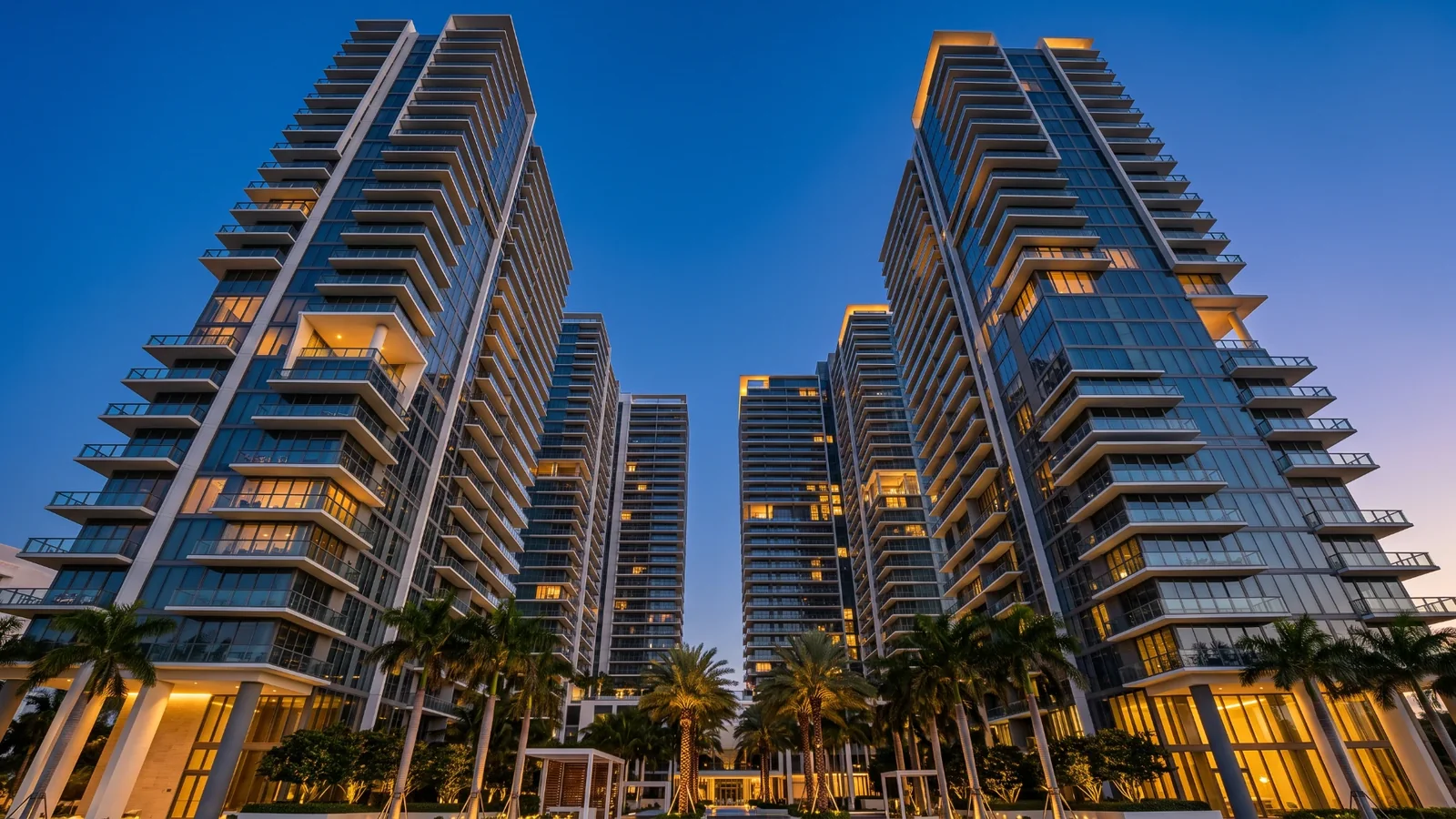
High-rise apartments in Miami, October 2026: 30 rental towers of 30+ floors, their heights, rents and fees, and the hurricane and elevator rules.
As of October 2026, our research counts 30 Miami-Dade rental towers of 30 floors or more, 24 open and six under construction, nearly all in Brickell, Downtown and Edgewater. The tallest is Panorama Tower, at 85 floors. In the 14 open towers that publish a base rent, one-bedrooms start at a median of $3,068 a month before fees.
These numbers come from our research on 217 purpose-built rental buildings in Miami-Dade, each owned by one company and leased through its own office. We have a recorded height for 104 of them, and 26 of those have 30 floors or more. Four more pass 30 floors by every published figure, but the figures differ, so we show the range: Downtown 1st, Neo Edgewater, Art Plaza and Gio Midtown. Prices were read on October 13, 2026. For what the extra rent buys in amenities at each price, see our guide to luxury apartments in Miami.
How many high-rise apartment buildings does Miami have?
It depends where you draw the line. The Florida Building Code calls a building a high-rise when it has an occupied floor more than 75 feet above the lowest level of fire department vehicle access, which takes in many mid-rise buildings too. Of the 104 Miami-Dade rental buildings in our files with a recorded height, 36 have fewer than 10 floors, 26 have 10 to 19, 16 have 20 to 29, 13 have 30 to 39, seven have 40 to 49 and six have 50 or more.
This guide uses 30 floors. By that measure, Miami-Dade has 30 rental towers in our research: 15 in Downtown, six in Brickell, six in Edgewater, and one each in Coconut Grove, Midtown/Wynwood and North Miami. The 24 that are open have more than 12,500 apartments between them, and every one with a known opening year opened in 2016 or later. Some are pairs of towers leased as one building: Downtown 5th is two 52-story towers with 1,042 apartments, and Square Station two 34-story towers with 710. Our comparison of Brickell, Downtown and Edgewater covers rents and transit in all three neighborhoods.
What are the tallest apartment towers in Miami?
These are the 24 open rental towers of 30 floors or more in Miami-Dade, from the tallest down, with each one's lowest advertised one-bedroom base rent on October 13, 2026, where it published one. Where published heights differ, the floors column shows the range.
| Building | Neighborhood | Floors | Apartments | Opened | 1-bed from |
|---|---|---|---|---|---|
| Panorama Tower | Brickell | 85 | 821 | 2018 | – |
| Downtown 1st | Downtown Miami | 56-57 | 560 | 2023 | – |
| Flow Brickell | Brickell | 54 | 632 | 2025 | $3,236 |
| Miami World Tower | Downtown Miami | 53 | 560 | 2024 | $3,210 |
| Downtown 5th | Downtown Miami | 52 | 1,042 | 2021 | – |
| Solitair Brickell | Brickell | 50 | 438 | 2018 | $3,046 |
| ParkLine Miami | Downtown Miami | 47 | 816 | – | $2,845 |
| Bezel at Miami Worldcenter | Downtown Miami | 43 | 434 | 2021 | – |
| CMPND Miami | Downtown Miami | 43 | 680 | 2026 | $2,711 |
| Flow Miami World | Downtown Miami | 43 | 444 | 2019 | $3,010 |
| Muze at Met Square | Downtown Miami | 43 | 391 | 2019 | – |
| Neo Edgewater | Edgewater | 40-42 | 399 | Pre-leasing | $3,605 |
| Forma Miami | Edgewater | 39 | 588 | 2024 | $2,920 |
| Melody Tower | Downtown Miami | 38 | 497 | 2016 | – |
| Cascade Link at Douglas | Coconut Grove | 37 | 421 | 2023 | $3,304 |
| 2000 Biscayne | Edgewater | 36 | 420 | 2024 | $3,089 |
| Miami Plaza | Downtown Miami | 36 | 425 | 2020 | – |
| Modera Riverside | Brickell | 36 | 428 | 2025 | $2,808 |
| Square Station | Downtown Miami | 34 | 710 | 2018 | – |
| Art Plaza | Downtown Miami | 33-36 | 667 | 2019 | – |
| Metro Edgewater | Edgewater | 32 | 279 | 2023 | $3,132 |
| Monarc at Met | Downtown Miami | 32 | – | 2016 | – |
| Alea | Downtown Miami | 31 | 464 | 2018 | $2,865 |
| Gio Midtown | Midtown/Wynwood | 31-39 | 447 | 2020 | $3,274 |
Panorama Tower, finished in 2018, rises 85 floors, about 868 feet, with 821 rentals, a Hyatt Centric hotel on its lower floors, offices and shops. Downtown 1st has its apartments on levels 15 to 56, with a pool deck on level 15, and Flow Brickell, 54 floors, has a 17-slip marina on the Miami River. Ten of the 24 open towers, including Panorama Tower, Downtown 1st and Downtown 5th, didn't publish a base rent we could use in October 2026. Monarc at Met's listed prices include its required fees, with one-bedrooms from $2,816, so it isn't in our base-rent figures.
How much do high-rise apartments in Miami cost?
More than the county as a whole, and somewhat more than the other buildings around them. The table compares median starting base rents in October 2026 for the open towers, for the other 37 rental buildings in Brickell, Downtown, Edgewater and Midtown/Wynwood (under 30 floors or with no recorded height), and for all of Miami-Dade. The number in brackets shows how many buildings published a price.
| Size | Towers of 30+ floors | Other buildings, same four areas | All Miami-Dade |
|---|---|---|---|
| Studio | $2,387 (5) | $2,369 (15) | $2,350 (35) |
| 1-bedroom | $3,068 (14) | $2,750 (27) | $2,603 (102) |
| 2-bedroom | $4,151 (6) | $3,740 (20) | $3,312 (69) |
| 3-bedroom | $5,895 (4) | $5,155 (9) | $4,394 (41) |
The one-bedroom gap is the clearest, because it rests on the most buildings: about $318 a month above the other buildings in the same four areas and $465 above the county median. Studios cost about the same, and the two- and three-bedroom tower medians rest on only six and four buildings. Among the towers, one-bedrooms started lowest at CMPND Miami, $2,711, Modera Riverside, $2,808, and ParkLine Miami, $2,845, and highest at Neo Edgewater, $3,605, Cascade Link at Douglas, $3,304, and Gio Midtown, $3,274. For medians in every neighborhood, see average rent in Miami by neighborhood.
Do higher floors and views cost more in a Miami high-rise?
Our data can't put a number on a view. We record each building's lowest advertised price, which may be for a lower floor or a plan without the best outlook. The spread inside one building gives a sense of the range: in the 13 towers that showed more than one one-bedroom price on October 13, 2026, the highest was a median of about $870, or 31 percent, above the lowest. At Forma Miami, one-bedrooms ran from $2,920 to $4,335, at Miami World Tower from $3,210 to $4,755 and at Flow Brickell from $3,236 to $4,508, while Metro Edgewater's ran only from $3,132 to $3,407. Those spreads mix floor, view, size and lease length, so ask which floor and direction a quoted apartment has.
Some buildings list the views. Flow Brickell, Flow Miami World and Metro Edgewater list water, skyline or bay views from select apartments, and Gio Midtown lists bay views from many homes. Nineteen of the 24 open towers list floor-to-ceiling windows or glass doors. Several also put shared space up high: ParkLine Miami's two towers, of 44 and 47 floors, are joined by a two-acre sky park about 150 feet up, Solitair Brickell has a 48th-floor billiard lounge, Modera Riverside a 36th-floor lounge and Metro Edgewater a sky lounge with bay and city views.
What fees and extras come with a Miami high-rise apartment?
Four towers publish both a base rent and a total monthly price. On October 13, 2026, the difference was $60 at Monarc at Met, $65 at Cascade Link at Douglas, $115 at Metro Edgewater and $120 at Miami World Tower. Metro Edgewater itemizes its $115: $45 for internet, $25 for trash, a $35 community amenity fee, $5 for pest control and $5 for utility billing. ParkLine Miami charges a separate required amenity fee of $250 a month, plus $25 for trash and smaller charges. Across all 39 buildings in our catalog that publish both figures, the median difference is about $71.
Parking and pets add more. Miami World Tower charges $175 to $500 a month for reserved parking, and ParkLine Miami $100 for a first unreserved space and $250 for a second. Melody Tower, Miami Plaza and Monarc at Met offer valet parking without a published price. For pets, Miami World Tower lists a $500 one-time fee plus $30 a month, ParkLine Miami $500 per pet plus $65 a month, and 2000 Biscayne $400 plus $40 a month per pet, with a limit of two.
Six of the 24 open towers advertised free rent in October 2026: Flow Miami World up to three months on select apartments, Miami World Tower up to six weeks, ParkLine Miami up to six weeks on select homes, Monarc at Met a month on studios and one-bedrooms and up to six weeks on two-bedrooms, Cascade Link at Douglas a month on select one- and two-bedroom plans, and Neo Edgewater a month on 14- to 18-month leases. Those were October 2026 offers, so ask us what a building offers now. Flow Brickell, Flow Miami World and ParkLine Miami also listed furnished apartments in October 2026.
Which new high-rise rentals are coming to Miami?
Six more rental towers of 30 floors or more were under construction in Miami-Dade in October 2026, with 3,074 apartments between them. The dates below are the latest targets their developers or the press had given by then, and they can slip.
- Downtown 6, Downtown Miami: 54 floors and 824 apartments, next to Downtown 5th. It topped out in March 2026 and was due in late 2026.
- 1775 Biscayne, Edgewater: 42 floors and 544 apartments, due in late 2028.
- One Twenty Brickell, Brickell: a 41-story rental tower with 537 apartments that shares its amenities with a condo tower, due in 2028.
- The Brickell Starlite, Brickell: 39 floors and 517 apartments, some with income limits, due in 2028.
- 2900 Terrace, Edgewater: 32 floors and 324 apartments. It topped out in 2026 and is due in late 2027.
- 2400 Laguna Circle, North Miami: 30 floors and 328 apartments at SoLé Mia. It was due in early 2025 when it broke ground in 2023, and we found nothing confirming it had opened by October 2026.
Our guide to new apartments in Miami tracks the rental buildings under construction across South Florida in our research, not only the towers.
How are Miami high-rises built for hurricanes?
Miami-Dade and Broward make up the Florida Building Code's High-Velocity Hurricane Zone, which has its own wind rules. Under the code's 2023 edition, structures in Miami-Dade are designed for a 3-second gust of 175 mph in Risk Category II, the class for most buildings, including most apartment buildings; a building with an occupant load over 5,000 falls in Risk Category III, designed for 186 mph. Broward's Risk Category II figure is 170 mph. The code's 2026 edition applies to permit applications submitted from December 31, 2026; a tower that's already standing was built to the edition in force when it was permitted. The code figures in this guide are from the 2023 edition.
Under the 2023 edition, windows and glass doors face a debris test that depends on height. Up to and including 30 feet above ground, test samples must survive two hits from a 9-pound 2x4 fired at 50 feet per second, about 34 mph. Above 30 feet, where almost all of a tower's windows are, they take 30 hits from 2-gram steel balls at 130 feet per second, about 89 mph. Glazing that passes is then put through cycles of positive and negative wind pressure, about 9,000 of them in the cyclic test required for a Miami-Dade product approval, according to the Florida Division of Emergency Management. Miami-Dade's product approval office keeps a public database of approved windows, doors and other products.
What happens to high-rise elevators when the power goes out?
The Florida Building Code's 2023 edition requires a high-rise to have a standby power system, and its elevators are on it. Where the standby source can run all the elevators in a group at once, they must switch to it automatically within 60 seconds after normal power fails. Where it can't, they switch over in turn, return to a set floor and disconnect, and at least one must keep running on standby power. A separate emergency power system runs exit signs and lighting along exit routes, elevator car lights, fire alarms and fire pumps.
Unless the code says otherwise, these systems must be able to run for at least 2 hours. That's a fire-safety minimum, not a promise of normal elevator service for days after a hurricane, so ask a building which elevators and common areas its generator runs and how long its fuel lasts.
Florida law also covers the elevators themselves. A building more than three stories high must have at least one passenger elevator that fits an ambulance stretcher 76 inches long and 24 inches wide, lying flat (Florida Statutes, s. 399.035). Elevators must be inspected every year, and the certificate of operation must be posted on the elevator, framed under a clear cover (ss. 399.061 and 399.07). Miami-Dade County, the City of Miami, Miami Beach and Broward County carry out those inspections and issue the certificates under contracts with the state.
What other safety rules apply to Miami high-rises?
The 2023 building code also requires a high-rise to have automatic sprinklers throughout. Exit stairs serving floors more than 75 feet up must be smokeproof enclosures, and a building with an occupied floor more than 120 feet up needs at least two fire service access elevators for firefighters, each able to carry at least 3,500 pounds.
Older towers face a county check. Miami-Dade requires most buildings to be recertified at 30 years and every 10 years after that, with reports from a Florida-registered engineer or architect certifying that the building is structurally and electrically fit for continued occupancy, and buildings of four stories or more must be inspected separately by structural and electrical engineers. Where one of those buildings has a facade of structural sealant glazing, glass held in place by structural adhesive, the Florida Building Code requires that glazing to be inspected every five years after installation. Every open tower in our list with a known opening year was built in 2016 or later, so none reaches its first 30-year recertification before 2046.
Do you have to evacuate a Miami high-rise in a hurricane?
Plan to leave if your building's zone is ordered to evacuate. Miami-Dade orders evacuations by storm surge planning zone, depending on a storm's track and projected surge rather than its category, and its zone guidance doesn't make exceptions for upper floors. Zone A is at risk of surge in Category 1 or stronger storms, Zone B in Category 2 or stronger, Zone C in Category 3 or stronger, Zone D in Category 4 or stronger, and Zone E only in a Category 5.
We checked each open tower's location on the county's zone map. Fifteen of the 24 are in Zone B, including every open tower in Brickell. Four are in Zone C: Forma Miami, Metro Edgewater and Neo Edgewater in Edgewater and Cascade Link at Douglas in Coconut Grove. Four are in Zone E: Miami World Tower, Miami Plaza, Square Station and Art Plaza. Gio Midtown appears to be outside the zones, though we have only an approximate location for it, and 2400 Laguna Circle, still under construction, is in Zone A. Surge zones are separate from flood zones; our guide to living in Miami explains both lookups.
Are there high-rise apartments in Fort Lauderdale or West Palm Beach?
Fort Lauderdale has nine rental towers of 30 floors or more in our research, led by Icon Las Olas at 45 floors and Alluvion Las Olas and Gables Riverwalk at 43. In the six with a one-bedroom base rent in October 2026, the median was $2,975, from $2,685 at Society Las Olas to $3,600 at Icon Las Olas, against $2,286 across all of Broward. Broward follows the same High-Velocity Hurricane Zone rules, with a 170 mph design gust for Risk Category II under the 2023 code. Palm Beach County has no rental tower of 30 floors in our research: the tallest open building with a recorded height is ParkLine Palm Beaches in West Palm Beach, at 25 floors.
What should you check before renting in a Miami high-rise?
- Ask which floor and direction the quoted apartment has, and what the same plan costs a few floors up or down.
- Get the total monthly price with required fees, parking and pet rent, on the same lease length, from every tower you compare.
- Ask what the generator runs, which elevators and for how long, and whether move-ins need a reserved elevator time.
- Look up the building's storm surge planning zone and flood zone on the county's maps before you sign.
- Ask whether the windows and balcony doors are impact-rated or need shutters before a storm.
- Check that the elevator's certificate of operation is posted and current.
- Set a budget with the affordability calculator, and add up deposits and fees with the move-in cost calculator.
- Compare neighborhoods with average rent in Miami by neighborhood, and if you're moving here, start with our guide to renting in South Florida.
These are asking rents in purpose-built rental buildings, not every high-rise apartment in Miami. Condos rented out by their owners aren't included, and prices change daily. Each building's MiaRent page shows its current starting rents, and from there you can ask us about it or book a showing.
Building codes and statutes change: this summary reflects the Florida Statutes and county rules in force in October 2026 and the 2023 edition of the Florida Building Code. This is general information, not legal advice.
Frequently asked questions
What is the tallest apartment building in Miami?
Among the rental buildings in our research, it's Panorama Tower in Brickell: 85 floors and about 868 feet, with 821 rental apartments above a hotel, finished in 2018. Next come Downtown 1st, at 56 or 57 floors depending on the source, then Flow Brickell and Downtown 6, which was under construction in October 2026, at 54. Condo towers aren't part of our research.
How much is a high-rise apartment in Miami?
As of October 2026, one-bedrooms in Miami-Dade rental towers of 30 floors or more start at a median of $3,068 a month in base rent, across the 14 open towers that publish one, from $2,711 at CMPND Miami to $3,605 at Neo Edgewater. Studios start at a median of $2,387 (five towers) and two-bedrooms at $4,151 (six). Required fees come on top: $60 to $120 a month at the four towers that publish a total price, and a $250 amenity fee at ParkLine Miami.
Where are the high-rise apartments in Miami?
Mostly in Downtown Miami, which has 15 of the 30 rental towers of 30 floors or more in our research, followed by Brickell and Edgewater with six each. Outside those three, Cascade Link at Douglas in Coconut Grove has 37 floors, Gio Midtown in Midtown/Wynwood 31 or 39, depending on the source, and 2400 Laguna Circle, under construction in North Miami, 30.
Do Miami high-rises have generators for the elevators?
The Florida Building Code's 2023 edition requires a high-rise to have standby power for its elevators, and emergency power for exit lighting and fire alarms. Elevators must switch over automatically within 60 seconds where the standby source can run them all, and at least one must keep running where it can't. The code's general minimum run time for these systems is 2 hours, so ask how long a building's generator can keep the elevators going after a storm.
Are windows in Miami high-rises hurricane-resistant?
In Miami-Dade, windows, glass doors and shutters are tested under the High-Velocity Hurricane Zone impact rules of the Florida Building Code's 2023 edition: a 9-pound 2x4 at about 34 mph up to 30 feet above ground, and 30 hits from 2-gram steel balls at about 89 mph above 30 feet, followed by thousands of wind pressure cycles. Ask a building whether its windows are impact-rated or need shutters before a storm.
Do you have to evacuate a Miami high-rise in a hurricane?
Plan to leave if your building's storm surge planning zone is ordered to evacuate; Miami-Dade orders evacuations by zone, and its zone guidance doesn't make exceptions for upper floors. By location, 15 of the 24 open rental towers in our research are in Zone B, at risk of surge in Category 2 or stronger storms, four are in Zone C and four in Zone E. You can look up any address on the county's Know Your Zone map.
Sources (12)
- MiaRent building research, October 2026 (410 purpose-built rental buildings, 217 of them in Miami-Dade; heights, rents, fees, specials and amenities read October 12-13, 2026)
- Florida Building Commission: Florida Building Code, Building, 8th Edition (2023), sections 202 (high-rise building; High-Velocity Hurricane Zone), 403.3, 403.4.8, 403.5.4, 403.6.1, 1604.5, 1620.2, 1626, 2702.1.5 and 3003.1
- Miami-Dade County Regulatory and Economic Resources: Florida Building Code 9th Edition code change (effective December 31, 2026)
- Florida Division of Emergency Management: Hurricane Retrofit Guide, Debris Impact Standards
- Miami-Dade County: Product Approval
- Miami-Dade County: Building Recertification (Code of Miami-Dade County, s. 8-11(f); structural glazing, Florida Building Code s. 2415.7.4)
- Florida Statutes 2026, s. 399.035: elevator accessibility requirements (ambulance stretcher)
- Florida Statutes 2026, s. 399.061: inspections
- Florida Statutes 2026, s. 399.07: certificates of operation
- Florida Department of Business and Professional Regulation, Bureau of Elevator Safety: Contracted Jurisdictions
- Miami-Dade County: Storm Surge Planning Zones
- Miami-Dade County: Know Your Zone map (storm surge planning zone data, queried October 14, 2026)
Get three buildings that fit you
Tell us what you need. A coordinator picks three buildings that fit and arranges the showings with you.
What will your apartment really cost?
Add up rent, deposit and fees before you apply.
Open the calculator